We are delighted to announce that our Online Relationship Counselling CPD model, which makes up part of this qualification, is now fully CPD Certified by the CPD Certification Service. We have worked hard to ensure the online part of this course meets all the requirements to offer certified training to our learners.
We are also pleased to announce that all Live Training weekends are fully certified by the CPCAB and hold the CPCAB-endorsed CPD certificate.
Course Description. If you do not want to do our live weekends and just the Online Relationship Course, you can start this immediately, knowing that the course is CPD-certified. Immediate start of online training |
(Course Review February 2026- Attending this couple's training has been an exceptionally valuable and enriching experience. The course is well structured with a clear progression.)
(Course Review September 2026- The live training has been exceptional. The content is relevant to today's relationship struggles)
(Tutor support has been excellent. Knowledgeable, responsive and encouraging which creates a safe and engaging learning environment.)
Aloe Level 5 Diploma in Relationship Counselling
Specialist training to work confidently, ethically and effectively with couples and relational systems.
Practical and deeply relevant, this course transformed how I work with relationships.
Online + in-person w/ends
26 self-paced modules
St Ives, Cambridgeshire
6-7 February 2027
10-11 April 2027
1-2 May 2027
12-13 June 2027
Course overview
The Aloe Level 5 Diploma in Relationship Counselling is a specialist, practice-focused qualification for qualified counsellors who wish to deepen their expertise in relational and couple work.
Designed to reflect contemporary relational practice, this programme blends online theoretical modules with immersive in-person experiential weekends.
You’ll learn advanced relational frameworks, evidence-informed interventions and reflective clinical skills that support ethical, confident practice with diverse relationship presentations.
This course is suitable for those who are:
- Qualified counsellors with CPCAB Level 4 Diploma or equivalent
- Practitioners ready to specialise in relational and couple work
- Those seeking deeper understanding of contemporary relationship dynamics
- Therapists wanting strong clinical and assessment competence
Course tutors
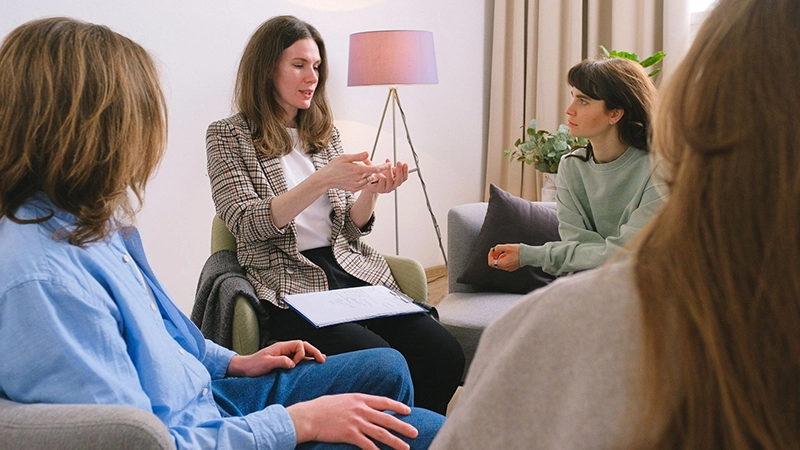
This course is led by experienced CPCAB-recognised tutors with extensive practice in relational and couple counselling.
Tutors draw from Person-Centred foundations and integrated modalities including Emotionally Focused Therapy (EFT), Transactional Analysis (TA), Imago Therapy, systemic models and attachment theory, giving learners a rich, relational skillset rooted in real practice.
Supervision is integrated into learning to support reflective development and clinical confidence.
Professional outcomes after Level 5
After completing this diploma, you will be prepared to work ethically and competently with individuals, couples and relational systems in professional settings. Key progression outcomes include:
- Confidence and competence in relational assessment and interventions
- Specialist practice with diverse relationship structures and presentations
- Advanced reflective practice and ethical decision-making
- Professional progression into private practice, agency roles or specialist services
- Pathways to accredited professional membership with BACP, NCPS and other registers

Course timings and content
Course format, dates and schedule
The course combines flexible online study with face-to-face experiential learning carried out over four in-person weekends.
- Online training can begin immediately upon enrolment
- The course includes 26 self-paced online learning modules
- Learning is supported by scheduled in-person training weekends
- Four in-person weekends are currently scheduled in February, March, May and June
- In-person weekends are held at our centre in St Ives, Cambridgeshire
What you will learn
This course explores integrative relationship frameworks and evidence-informed approaches, covering:
- Foundations of relational counselling and relational identity
- Attachment theory and emotional regulation in couple work
- Relational conflict, communication and emotional safety
- Systemic and family systems theory
- Emotionally Focused Therapy principles
- Transactional Analysis and integrative models
- Cultural, gender and diversity-focused relational competence
- Contemporary relational challenges including digital intimacy, neurodiverse relationships and blended families
- Psychosexual aspects of relational work and assessment
- Advanced case formulation and therapeutic structure
Course curriculum
The exact course curriculum is as follows:
PART 1 – Foundations of Relationship Counselling (Modules 1–9) Key Areas:
- Identity and role of the relationship counsellor
- Pre-screening, assessment, communication foundations
- Attachment theory and emotional regulation
- Emotionally Focused Therapy principles
- Relational trauma and containment
- Cultural awareness and diversity
- Systemic and genogram work
- Transactional analysis
- Overcoming relational blocks
PART 2 – Advanced Relational Practice (Modules 10–17):
- Helping couples to separate amicably
- Parental alienation in split families
- Dating in the modern age
- Supporting blended families
- Additional topics
- Gender and relationship structures
- Cultural and intersectional competence
- Narcissistic dynamics
PART 3 – Working with Coercion, Control & Mentalisation Themes (Modules 18–24):
- Coercive and controlling behaviour
- Gaslighting, minimising, isolation
- Risk assessment and safety decisions
- Narcissistic and high-conflict presentations
- Mentalisation and emotional regulation
- De-escalation and rupture repair
- Infidelity
PART 4 – Psychosexual Relationship Training:
Building upon the exploration of narcissistic dynamics and the complexities of coercion, control, and mentalisation, this section delves into the multifaceted nature of psychosexual relationships. Emphasizing comprehensive assessment and understanding of sexual histories, the focus shifts toward desire, arousal, and the varied aspects of sexual functioning within partnerships. Contemporary challenges such as pornography use, addiction, and digital sexual culture are examined alongside considerations for sexual identity, LGBTQIA+ inclusion, and the impact of trauma and dissociation on embodied safety. The training also addresses the nuances of consent, sexual power dynamics, and coercion, providing guidance on navigating addiction, shame cycles, and fostering recovery. Ultimately, this part aims to cultivate skills for supporting healthy intimacy, enriching eroticism, and enhancing communication within diverse relational contexts.
Themes:
- Psychosexual assessment and history
- Desire, arousal, and sexual functioning
- Pornography, addiction & digital sexual culture
- Trauma, dissociation and embodied safety
- Consent, sexual power dynamics and coercion
- Addiction, shame cycles and recovery
- Healthy intimacy, eroticism and communication
Residential training weekends:
- Weekend 1: Safety and Structure
- Weekend 2: Boundaries and Movement
- Weekend 3: Control and Mentalisation
- Weekend 4: Psychosexual Relationship Training
Learning outcomes
You will develop advanced competencies to:
- Assess, conceptualise and work ethically with complex relational presentations
- Integrate multiple theoretical models into practice
- Navigate diversity, identity and contextual factors in couple work
- Apply reflective practice to clinical decision-making
- Demonstrate relational and systemic clinical judgment
How you will learn
Learning combines:
- 26 online theoretical modules for flexible study
- 4 experiential in-person residential weekends with live skills practice
- Case reflection and supervision integration
- Group discussion, role-play, demonstrations and reflective tasks
- Ongoing tutor support and cohort collaboration
Fees and additional costs
The current course fee is £1,200, with payment options including a six-month instalment plan.
Additional costs may include:
- Textbooks or materials
Entry, study and assessment requirements
Entry requirements
Applicants must hold a CPCAB Level 4 Diploma in Therapeutic Counselling or an equivalent professional counselling qualification.
Applicants are also required to provide a supervisor’s or line manager’s letter confirming readiness for advanced relational training and attend an interview to discuss suitability and preparedness for specialist work.
Study expectations
This diploma requires sustained engagement with both online learning and in-person experiential work. Consistent study, reflective tasks and completion of supervision logs are integral to successful progression.
You will be required to attend 4 residential weekends.
Assessment & integration
Assessment is portfolio-based, combining reflective journals, supervision logs, observed practice and a case study. Successful completion evidences your ability to work ethically, reflectively and competently with relational complexity.
You will demonstrate your learning through:
- Observed relational skills during residential weekends
- Reflective journals and learning logs
- A 5,000-word case study integrating theory and practice
- Portfolio evidence showing clinical competence and professional growth
What our students say
This relationship counselling training expanded my confidence and skill to work with diverse couple cases. The practical focus and supervision were invaluable.
The blend of online modules and experiential weekends helped me integrate theory and real practice with clarity and support.
Great training delivered with authenticity, depth and ethical confidence!
Improve your Relationship Counselling knowledge
Begin the Level 5 Relationship Counselling Diploma online at your own pace, with in-person residential weekends starting in July 2026.